
Practical Guide
Chandra Gayatri Mantra: Lyrics, Meaning & How to Chant
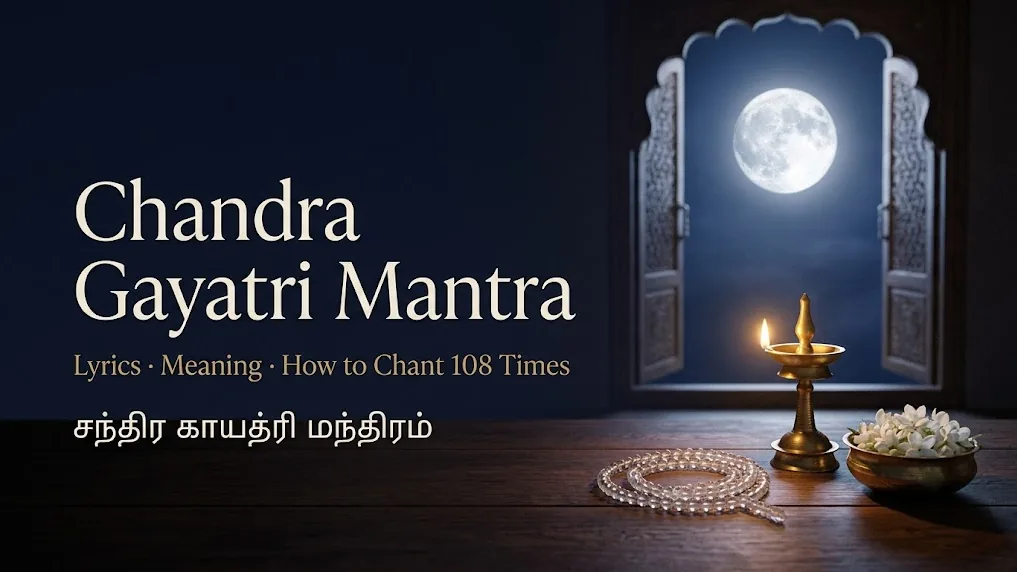
The Chandra Gayatri mantra most often chanted in Tamil homes is: Om Padmadhwajaya Vidmahe, Hema Roopaya Dheemahi, Thanno Chandra Prachodayat. It is the Gayatri of Chandra, the Moon, one of the nine Navagrahas, and it follows the same three-line pattern as every Gayatri mantra: we seek to know the deity, we meditate on the deity, and we ask the deity to light up our thinking. Below you will find all three versions in common use (also spelt Chandra Gayathri or Chandran Gayatri), what each word means, and a simple way to chant it 108 times on a Monday, a full moon or your Chandrashtama day.
Author: Chandrashtama.in Editorial TeamLast reviewed: 4 min read
Short answer
Chandra Gayatri Mantra
Chandra Gayatri mantra lyrics in English, Tamil and Sanskrit, the 3 versions in use, line-by-line meaning, and how to chant it 108 times.
On this page
The Chandra Gayatri mantra in English, Tamil and Sanskrit
Three versions of the Chandra Gayatri are printed in prayer books and temple cards. All three share the closing request, Tanno Chandrah (or Somah) Prachodayat, "may the Moon light up our mind". They differ in the names they use for the Moon in the first two lines.
If your family or temple already follows one version, keep to it. If you are starting fresh, the first version below is the one most Tamil households and Navagraha lists use.
The three Chandra Gayatri versions in use
Version 1
Padmadhwajaya
- English transliteration
- Om Padmadhwajaya Vidmahe, Hema Roopaya Dheemahi, Thanno Chandra Prachodayat
- Tamil script
- ஓம் பத்மத்வஜாய வித்மஹே, ஹேம ரூபாய தீமஹி, தந்நோ சந்திர ப்ரசோதயாத்
- Sanskrit (Devanagari)
- ॐ पद्मध्वजाय विद्महे । हेमरूपाय धीमहि । तन्नो चन्द्रः प्रचोदयात् ॥
Version 2
Kshira Putraya
- English transliteration
- Om Kshira Putraya Vidmahe, Amrita Tattvaya Dheemahi, Thanno Chandra Prachodayat
- Tamil script
- ஓம் க்ஷீர புத்ராய வித்மஹே, அம்ருத தத்வாய தீமஹி, தந்நோ சந்திர ப்ரசோதயாத்
- Sanskrit (Devanagari)
- ॐ क्षीरपुत्राय विद्महे । अमृततत्त्वाय धीमहि । तन्नो चन्द्रः प्रचोदयात् ॥
Version 3
Amritangaya
- English transliteration
- Om Amritangaya Vidmahe, Kala Roopaya Dheemahi, Thanno Soma Prachodayat
- Tamil script
- ஓம் அம்ருதாங்காய வித்மஹே, கலா ரூபாய தீமஹி, தந்நோ ஸோம ப்ரசோதயாத்
- Sanskrit (Devanagari)
- ॐ अमृताङ्गाय विद्महे । कलारूपाय धीमहि । तन्नो सोमः प्रचोदयात् ॥
Chandra Gayatri mantra meaning, line by line
Every Gayatri mantra has the same frame. Vidmahe means "may we know", Dheemahi means "we meditate on", and Tanno … Prachodayat means "may that one inspire us" or "light up our understanding". Only the names change from deity to deity, and for the Moon those names describe what Chandra is in the old stories.
In the first version, Padmadhwaja is "the one whose banner carries the lotus", and Hema Roopa is "the one with a golden, shining form". Put together, the mantra reads: "May we know the Moon whose banner bears the lotus; we meditate on the one of golden radiance; may Chandra light up our mind."
In the second version, Kshira Putra means "son of the ocean of milk". It recalls the Puranic story in which the Moon rose from the churning of the milk ocean. Amrita Tattva means "the one whose essence is nectar". In the third version, Amritanga is "the one whose body is nectar", Kala Roopa is "the one who takes the form of the kalas", the digits by which the Moon waxes and wanes, and Soma is another name for the Moon.
| Word | Meaning |
|---|---|
| Vidmahe | May we know, may we understand |
| Dheemahi | We meditate on |
| Tanno … Prachodayat | May that one inspire us, light up our mind |
| Padmadhwaja | One whose banner bears the lotus |
| Hema Roopa | One of golden, shining form |
| Kshira Putra | Son of the ocean of milk |
| Amrita Tattva | One whose essence is nectar |
| Kala Roopa | One who takes the form of the Moon’s phases (kalas) |
| Chandra, Soma | The Moon |
How to chant the Chandra Gayatri mantra 108 times
1. Choose the time. Monday (Somavaram) is the Moon’s day, and the evening after moonrise is the traditional hour. Full moon (Pournami) evenings are also favoured. Early morning after a bath works just as well if evenings are busy.
2. Prepare a small, clean place. Light a lamp with ghee or sesame oil, and sit on a mat facing east or north. Many families keep white flowers, a little milk or rice nearby, since white is the colour linked with the Moon. None of this is required. A quiet corner and a steady posture are enough.
3. Use a japa mala to count. A japa mala has 108 beads and one larger bead, the meru or guru bead. Start next to the meru and move one bead per recitation, rolling it with the thumb and middle finger. When you reach the meru again, do not cross it. Turn the mala around and continue in the other direction if you are doing more than one round. Sphatik (clear quartz), rudraksha and Karungali (ebony) malas are all used for Chandra japa.
4. Keep an even pace. At a calm pace, 108 recitations take about 12 to 18 minutes. You can chant aloud, whisper, or repeat silently. Whispering is a good middle path when others are around. If 108 feels long at first, 27 or 54 is a fine start. A steady daily count matters more than a large one done once.
5. Close quietly. Sit for a minute after the last bead before getting up, and offer a short prayer in your own words.
When to chant: Mondays, Pournami and Chandrashtama days
Many people chant the Chandra Gayatri every Monday as a weekly practice. Others keep it for the days when the Moon is said to be weak for them. Chandrashtama is the best known of these: the roughly two-and-a-half days each month when the Moon passes through the eighth sign from your janma rasi (see what Chandrashtama is). Tradition advises a quieter, more inward day then, and a Moon mantra fits that well.
To find your next Chandrashtama window, open today’s Chandrashtama and pick your rasi, or see the full 2027 Chandrashtama calendar. If you are not sure of your rasi, find your janma rasi first. Pair the mantra with the practical advice in our Chandrashtama dos and don’ts.
We do not claim that chanting changes your dates or their effects. It is a devotional practice that many people find steadying. Use it alongside sensible planning, not instead of it.
Other Chandra mantras
Some readers are looking for a shorter mantra or the Navagraha verse for the Moon. These are the ones most often recited with or instead of the Gayatri.
| Mantra | Words | Tamil script | Use |
|---|---|---|---|
| Chandra moola mantra | Om Soma Somaya Namah | ஓம் ஸோம ஸோமாய நமஹ | A short name-mantra, easy for daily counts of 108 |
| Chandra beeja mantra | Om Shraam Shreem Shraum Sah Chandraya Namah | ஓம் ஷ்ராம் ஷ்ரீம் ஷ்ரௌம் ஸஹ சந்திராய நமஹ | The seed-syllable mantra, often given with a fixed count by a teacher |
| Navagraha stotram verse for Chandra | Dadhi Shankha Tusharabham, Kshirodarnava Sambhavam, Namami Shashinam Somam, Shambhor Mukuta Bhushanam | ததி சங்க துஷாராபம், க்ஷீரோதார்ணவ ஸம்பவம், நமாமி சசினம் ஸோமம், சம்போர் மகுட பூஷணம் | "I bow to the Moon, white as curd, conch and snow, born of the milk ocean, the jewel on Shiva’s crown" |
Pronunciation guide
Clear, unhurried pronunciation matters more than speed. Long vowels are held for about twice as long as short ones. The syllable breaks below follow the common Tamil-home version.
| Word | Say it as | Tip |
|---|---|---|
| Padmadhwajaya | pad-ma-dhva-jaa-ya | The "dh" is soft and breathy, as in the Tamil த |
| Vidmahe | vid-ma-hay | Stress falls lightly on "ma" |
| Hema Roopaya | hay-ma roo-paa-ya | Hold the long "oo" and "aa" |
| Dheemahi | dhee-ma-hi | Long "ee" at the start |
| Thanno | than-no | Double "n", held briefly |
| Chandra | chan-dra | Not "chun-dra"; the first "a" is short and open |
| Prachodayat | pra-cho-da-yaat | Hold the final "aa" and end on a soft "t" |
Chandrashtama.in Editorial Team
Vedic Timing & Research
The Chandrashtama.in Editorial Desk focuses on bridging the gap between traditional Vedic astrological rhythms and modern mindful living. Our mission is to provide clear, data-driven insights to help readers navigate their daily timing with confidence.
Is today a Chandrashtama day for you?
FAQ
Frequently Asked Questions
Which Chandra Gayatri mantra is correct?
All three versions on this page are traditional. Om Padmadhwajaya Vidmahe is the one most used in Tamil homes, Om Kshira Putraya Vidmahe is widely printed, and Om Amritangaya Vidmahe ends with Soma instead of Chandra. Follow your family or temple tradition, and if you have none, use the first.
What is the meaning of the Chandra Gayatri mantra?
In the common version: "May we know the Moon whose banner bears the lotus; we meditate on the one of golden radiance; may Chandra light up our mind." The full word-by-word meaning is in the table above.
How many times should I chant the Chandra Gayatri mantra?
108 times is the traditional count, kept on a japa mala. At a calm pace it takes about 12 to 18 minutes. 27 or 54 is a good start if 108 feels long.
What is the best day to chant the Chandra Gayatri mantra?
Monday (Somavaram) is the Moon’s day, and the evening after moonrise is the traditional time. Full moon evenings and your own Chandrashtama days are also commonly chosen.
Can I chant the Chandra Gayatri mantra without a mala?
Yes. You can count on your fingers, use a counter, or simply chant for a fixed time such as ten minutes. A mala only helps you keep count without watching a clock.
Is Chandra Gayathri the same as Chandra Gayatri?
Yes. Gayathri and Gayatri are two English spellings of the same word. You may also see it called Chandran Gayatri or Soma Gayatri.
Related guides
Do's and Don'ts Guide
A bullet-pointed roadmap of rules, precautions, and best practices for the 48-hour window.

What is Chandrashtama?
What Chandrashtama means, which sign is yours, how long it lasts, and how to plan around it.

Mantras as Sound Therapy
Learn how chanting physically stimulates the vagus nerve to calm anxiety instantly.