
Practical Guide
What Is Chandrashtama? Meaning, Effects & Your Dates
Chandrashtama (Chandra = Moon, Ashtama = eighth) is the period of about 2¼ days, once every 27 days or so, when the Moon passes through the eighth sign from your Janma Rasi (your Moon sign at birth). Tradition treats it as a time for caution: postpone big beginnings, avoid arguments, and keep routine work going. In modern terms it is an "emotional low tide" rather than a period of bad luck, and knowing your dates lets you plan around it.
Short answer
What Is Chandrashtama? Meaning, Effects & Your Dates
Chandrashtama means “Moon in the eighth”: the 2¼ days each month when the Moon crosses the 8th sign from your Janma Rasi. Effects, what to avoid and your dates.
Author
Chandrashtama.in Editorial Team
Role
Vedic Timing & Research
Last reviewed
2026-09-15
EST. READING
6 minutes
1. Which Sign Is Your Chandrashtama?
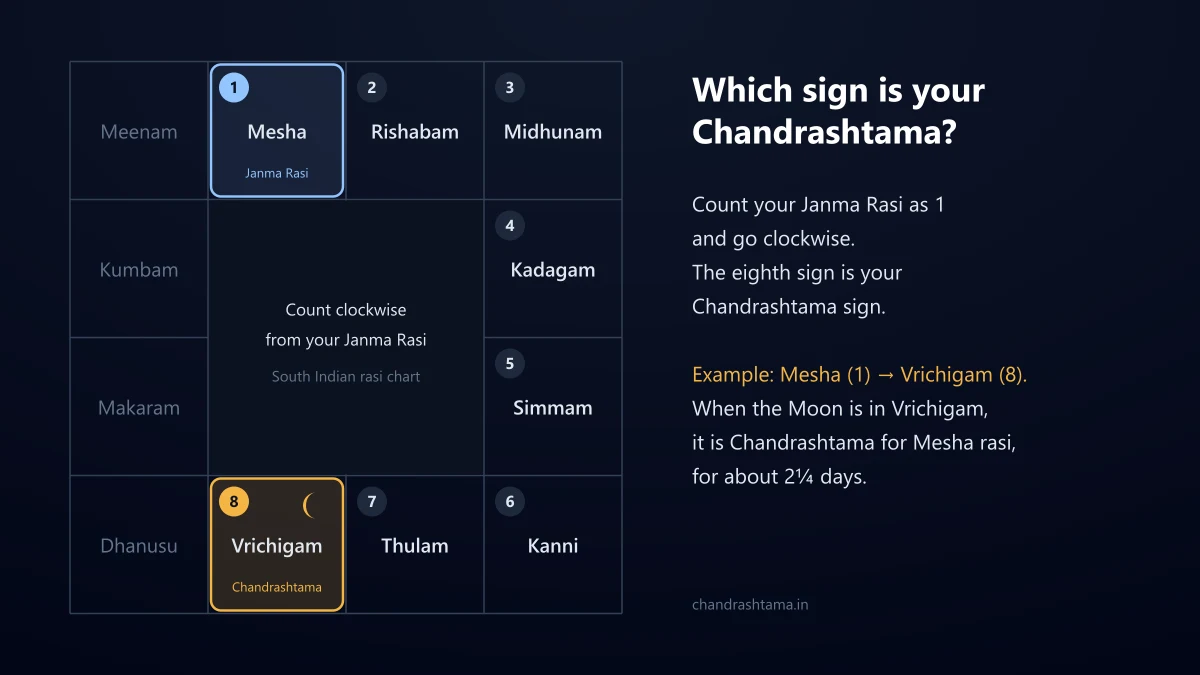
Count eight signs from your Janma Rasi, counting your own sign as the first. Your Chandrashtama begins when the Moon enters that sign and ends when it leaves. In our 2026–2027 data that takes 47 to 61 hours, 55 on average. The Moon comes back to the same sign about every 27 days, so each rasi has 13 or 14 Chandrashtama windows a year.
Each rasi in the table links to its page, which lists every window with exact start and end times in IST. The last column shows the stars the Moon passes through during the window; if you know your birth star, find it in the nakshatra directory.
| Your Janma Rasi | Chandrashtama when the Moon is in | Stars the Moon passes through then |
|---|---|---|
| Mesha (Aries) | Vrichigam | Vishakha (pada 4), Anuradha, Jyeshtha |
| Rishabam (Taurus) | Dhanusu | Mula, Purva Ashadha, Uttara Ashadha (pada 1) |
| Midhunam (Gemini) | Makaram | Uttara Ashadha (padas 2–4), Shravana, Dhanishta (padas 1–2) |
| Kadagam (Cancer) | Kumbam | Dhanishta (padas 3–4), Shatabhisha, Purva Bhadrapada (padas 1–3) |
| Simmam (Leo) | Meenam | Purva Bhadrapada (pada 4), Uttara Bhadrapada, Revati |
| Kanni (Virgo) | Mesha | Ashwini, Bharani, Krittika (pada 1) |
| Thulam (Libra) | Rishabam | Krittika (padas 2–4), Rohini, Mrigashira (padas 1–2) |
| Vrichigam (Scorpio) | Midhunam | Mrigashira (padas 3–4), Ardra, Punarvasu (padas 1–3) |
| Dhanusu (Sagittarius) | Kadagam | Punarvasu (pada 4), Pushya, Ashlesha |
| Makaram (Capricorn) | Simmam | Magha, Purva Phalguni, Uttara Phalguni (pada 1) |
| Kumbam (Aquarius) | Kanni | Uttara Phalguni (padas 2–4), Hasta, Chitra (padas 1–2) |
| Meenam (Pisces) | Thulam | Chitra (padas 3–4), Swati, Vishakha (padas 1–3) |
2. Is Chandrashtama Good or Bad?
Neither, in the way most people fear. Traditional astrology reads the eighth house as the place of obstacles and hidden matters, and the Moon as the mind. So Chandrashtama is read as about two days when judgment and patience run lower than usual, not as a time when bad events are fated. That is why the traditional advice is about timing: don't start major things, don't sign or argue in haste, and carry on with routine work. Our guide to what to avoid during Chandrashtama goes through it item by item.
Many people notice little at all. Tradition itself holds that the effect varies from chart to chart, and some astrologers say it is milder for certain birth stars. If a date really matters, such as a wedding or surgery, ask an astrologer who can read your full chart rather than going by the sign alone. It is also far shorter than Ashtama Sani, Saturn's two-and-a-half-year stay in the same eighth house, and if the days do feel heavy, these nine ways to steady your mind can help.
3. The Lunar Blueprint: Why the Eighth House?
To understand Chandrashtama, we must first look at what the Moon represents in Vedic astrology. The Moon is the Karaka (significator) of the Mind (Manas). It governs our emotions, our subconscious reactions, and the way we perceive the world. While the Sun represents our soul and external identity, the Moon represents our internal peace and mental clarity.
The zodiac is divided into twelve houses. Each house represents a specific area of life. The eighth house is traditionally associated with transformation, hidden things, and sometimes, sudden challenges. When the Moon, the ruler of our emotions, enters this "hidden" house, our internal signal can become slightly fuzzy. It is not that the world becomes more difficult; it is that our ability to handle the world's friction is temporarily reduced.
Think of it as entering a tunnel while driving. The road is still there, but the light is different, and you might lose your radio signal for a moment. If you panic and swerve, you might have an accident. If you simply turn on your headlights, slow down slightly, and maintain your course, you exit the tunnel perfectly safe. Chandrashtama is that tunnel.
4. The 27-Day Cycle: Nature's Rhythm
The Moon orbits the Earth in approximately 27.3 days. This means that every single person, regardless of their sign, faces a Chandrashtama period once a month. It is as natural as the cycle of sleep and wakefulness. Just as you wouldn't expect yourself to run a marathon at 3:00 AM when your body is programmed for rest, you shouldn't expect yourself to make high-stakes, emotionally charged decisions during your Chandrashtama. To understand the risks better, you can explore what to avoid during Chandrashtama.
By acknowledging this cycle, you stop blaming yourself for "bad days." You realize that your irritability, fatigue, or lack of focus isn't a personal failure; it is a biological and cosmic response to a specific energetic phase. This realization alone can reduce the stress of the period by half.
5. Common Myths vs. Reality
There is a common misconception that you should stop all activity during Chandrashtama. This is neither practical nor necessary. Our ancestors did not stop living; they simply shifted their intensity.
Myth: You shouldn't travel or work.
Reality: You can certainly travel and work. However, you should double-check your bookings and proofread your emails. Most "bad luck" reported during Chandrashtama is actually the result of avoidable human error caused by a lack of attention. By adding 10% more mindfulness to your routine, you can navigate the day flawlessly.
Myth: It is an unlucky time.
Reality: It is a "low patience" time. If you know your fuse is shorter, you can choose not to engage in arguments. If you choose not to argue, you avoid the "bad luck" of a broken relationship or a workplace conflict. The power is in your behavior, not in the stars.
6. Professional Life: Energy Management
In a corporate environment, you can't always tell your boss you are having a Chandrashtama. Instead, use energy management. Use these two days for "back-office" work: research, organizing files, planning, and solitary tasks. Avoid scheduling major presentations, contract negotiations, or performance reviews during these days if possible.
If you must lead a meeting, go in with the awareness that you might feel defensive. If someone criticizes your work, take a breath and wait five seconds before responding. That five-second gap is the difference between a professional response and a Chandrashtama-fueled outburst.
7. The Personal "24-Hour Rule"
One of the most effective strategies is the 24-hour rule. If a major decision or a heated discussion arises during Chandrashtama, tell the other party: "I hear you, but I need 24 hours to process this before I respond." Since the period only lasts two days, this simple delay usually carries you safely to the other side where your mental clarity is restored.
8. Why Do Chandrashtama Dates Differ Between Sites?
Calendars can disagree by a few minutes, sometimes more. There are three usual reasons.
Sign or star. Most calendars, including this one, time Chandrashtama by the Moon's sign. Some traditions count from your birth star instead, which gives a different window.
Ayanamsa. Vedic astrology measures the Moon against the fixed stars, and calendars use slightly different corrections for this. We use Lahiri, India's official standard.
Time zone and rounding. Our times are calculated to the minute, in IST.
We compute every date from the Moon's actual position using the Lahiri method, then check it against published panchang times: 203 of 206 sign changes matched to within two minutes. How Chandrashtama dates are calculated explains the method.
9. Conclusion: The Gift of Silence
Chandrashtama is an invitation to slow down. By honoring your "low tide" days, you keep your energy for your "high tide" days. Treat yourself as you would a tired friend: the Moon will move on, and clarity will return.
Chandrashtama.in Editorial Team
Vedic Timing & Research
The Chandrashtama.in Editorial Desk focuses on bridging the gap between traditional Vedic astrological rhythms and modern mindful living. Our mission is to provide clear, data-driven insights to help readers navigate their daily timing with confidence.
Check Current Month Dates
Quickly access the specific dates and timings for your rasi for the current month.
Frequently Asked Questions
What does Chandrashtama mean?
Chandra means Moon and Ashtama means eighth. It is the time when the Moon passes through the eighth sign from your Janma Rasi, about 2¼ days once a month.
Is Chandrashtama good or bad?
It is treated as a time for caution, not bad luck. Postpone major beginnings and heated decisions, and carry on with routine work.
How long does Chandrashtama last?
About 2¼ days. In our 2026–2027 data, windows run 47 to 61 hours, 55 on average.
How often does Chandrashtama come?
About every 27 days: 13 or 14 times a year for each rasi.
What should I avoid during Chandrashtama?
Traditionally: starting new ventures, major purchases or agreements, weddings and similar ceremonies, and heated arguments. Our guide on what to avoid during Chandrashtama has the full list.
Can I get married or start a new job on my Chandrashtama?
Tradition advises against fixing such dates on it. If a date is already fixed, astrologers weigh the full muhurtham and your chart, not the sign alone, so consult one.
How do I find my Chandrashtama dates?
Find your Janma Rasi, then open its page on this site. It lists every window with exact start and end times.